

This post contains affiliate links. If you buy through them, I may earn a small commission at no extra cost to you.
Every Apogee plugin is now on Plugin Alliance, and if you’re a subscriber, they come with your subscription. I hadn’t spent a ton of time with Apogee’s plugins before, so I went through the whole batch and picked out the three I think are worth your time: Clearmountain’s Domain, the officially licensed Pultec EQP-1A and Clearmountain’s Spaces.
Quick Comparison
| Plugin | What it is | My take |
|---|---|---|
| Clearmountain’s Domain | De-essers, two delays, pitch shifting and three reverbs in one plugin | Incredible sounds, but you have to put in time to dial it in |
| Pultec EQP-1A | The only Pultec EQP-1A plugin officially licensed by Pulse Techniques | Warmer and more open than the UAD Pultec on my drum loop |
| Clearmountain’s Spaces | A three-room reverb pulled from the Domain | The fastest way to a great reverb in the whole collection |
Why Apogee Plugins Ended Up on Plugin Alliance
If you haven’t been following the plugin news, a lot has changed about who owns what. Dirk Ulrich, who founded Brainworx and Plugin Alliance, sold both to the Native Instruments group back in 2021. Native Instruments then went through insolvency and its pieces got sold off, and in July 2026 Dirk bought Plugin Alliance and Brainworx back. In a related shakeup, iZotope is now part of Boris FX.
Honestly, Dirk coming back is fantastic news. When he sold, a lot of us were a little upset, and Plugin Alliance did start going downhill a bit. Having him back in charge is a good sign.
Here’s the part that explains the Apogee move. After Dirk stepped away from Plugin Alliance, he bought Manley Labs (yes, the Massive Passive Manley) and then Apogee. Now all of those companies sit under the same roof, so it makes sense that he’s merging them together. Apogee’s plugin catalog moving over to Plugin Alliance is the first big result of that.
A few practical things changed with the move:
- No more iLok. The Plugin Alliance versions drop the iLok requirement and get resizable windows.
- Existing owners get the new versions free, with three activations per license instead of two. Apogee recommends keeping your old iLok versions installed so older sessions still open.
- Two plugins didn’t make the move: the Mod EQ 6 and Mod Comp. Apogee says owners of those will get free upgrades to EQ and compressor options from the Plugin Alliance catalog.
1. Clearmountain’s Domain
Quick background first. Bob Clearmountain was a co-owner of Apogee, and a lot of people credit him with basically inventing the job of the dedicated mixing engineer. He’s mixed some of the biggest records ever made, David Bowie and Bruce Springsteen among them. A lot of the plugins in the Apogee collection are built around how he works, and the Domain is his whole effects chain in one box.
I reviewed this plugin when it first came out. I really liked it, but it was expensive and, honestly, a little confusing, so I never bought it. Now that it’s included with the subscription, the price problem is gone. The learning curve is still there. I’d love to see Plugin Alliance do a version two that’s a bit more intuitive, because this thing is fantastic once you dial it in.
How the Signal Flows
This is how I have it set up, which isn’t how it loads by default. I find it easier to work with this way.
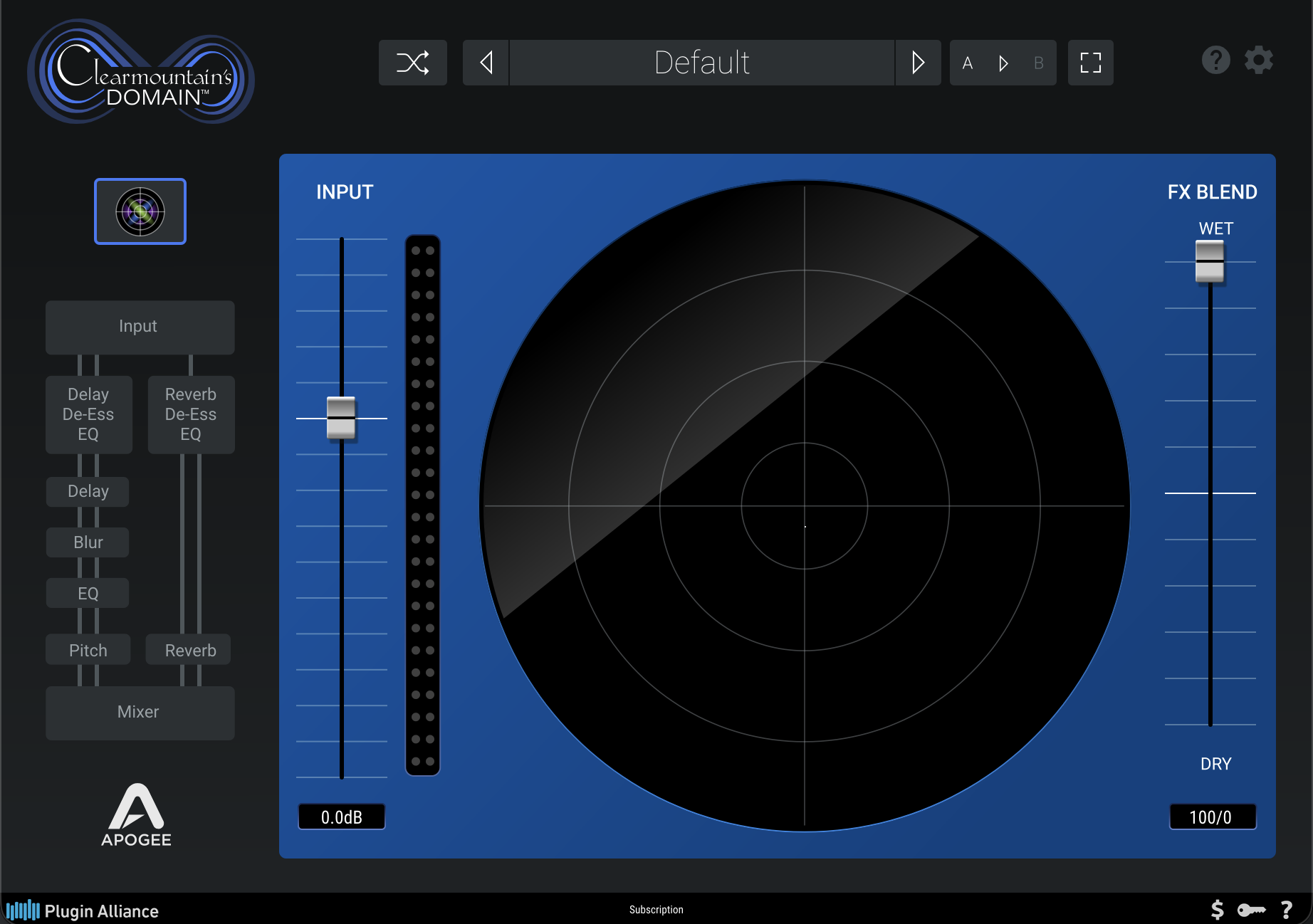
- Input de-essers. There’s a separate de-esser for the delay input and the reverb input, so the signal gets de-essed before it ever hits the effects. I always think that’s a great idea. I turn them both on.
- Delay. A basic syncable delay. On this vocal I’ve got a quarter note on the left and a quarter note on the right. “Spin” on this plugin is actually feedback, and I pulled it back a little. There are also EQs and link options, but I’m not getting into all of that here.
- Pitch and reverb sends. Think of this as three different reverb sends, each with its own pre-delay. You can feed the reverbs the direct signal, the delayed pitched signal, or both. Confusing, right?
- Pitch. You can shift the left and right channels up and down by cents or semitones, either fixed or moving. I have it moving roughly 21 cents on either side.
- Mixer. This is where I use the plugin the most. You get faders for the regular delay, the pitch delay and the three reverbs.
How I Use It
In the video, I’m using it on a vocal from the band Frozen Poppy Seed, from their song “Live-a-ling.” I start with everything in the mixer pulled down, then bring things up one at a time. The regular delay sounds like a regular delay. Bring up the pitch delay and you hear that pitch movement right away, so you really have two different delays to work with. I don’t know if I’d use both at once, but it’s nice to have the choice. Then I blend in the three reverbs, and the vocal goes from dry to huge pretty fast.
Here’s why that matters to me. In my normal mixes I have three reverbs, two or three delays and a micro pitch, all set up on different sends. (I broke down that setup in the reverb and delay chain I use on 90% of my mixes.) The Domain does all of that from one plugin.
I still like having my separate sends so I can swap things out. Where the Domain really shines for me is on a guitar or another part you just want to make sound different and give some vibe. Play with the mixer faders by ear and you can come up with some really interesting sounds.
Mixing & Mastering
Want a pro mix and master?
One engineer handles everything, start to finish. Credits include A$AP Rocky, Kelly Clarkson and Travis Barker.
2. Apogee Pultec EQP-1A vs. the UAD Pultec
Just what all of us need: another Pultec. But this one is different. It’s officially licensed and endorsed by Pulse Techniques, the company that makes Pultec hardware today, and Apogee modeled it from a brand new Pultec unit. In the video I guessed it might be the first officially licensed Pultec plugin, and as far as I can tell, Apogee’s EQP-1A is the only one Pulse Techniques has licensed and endorsed. The collection also includes a licensed MEQ-5, the Pultec midrange EQ.
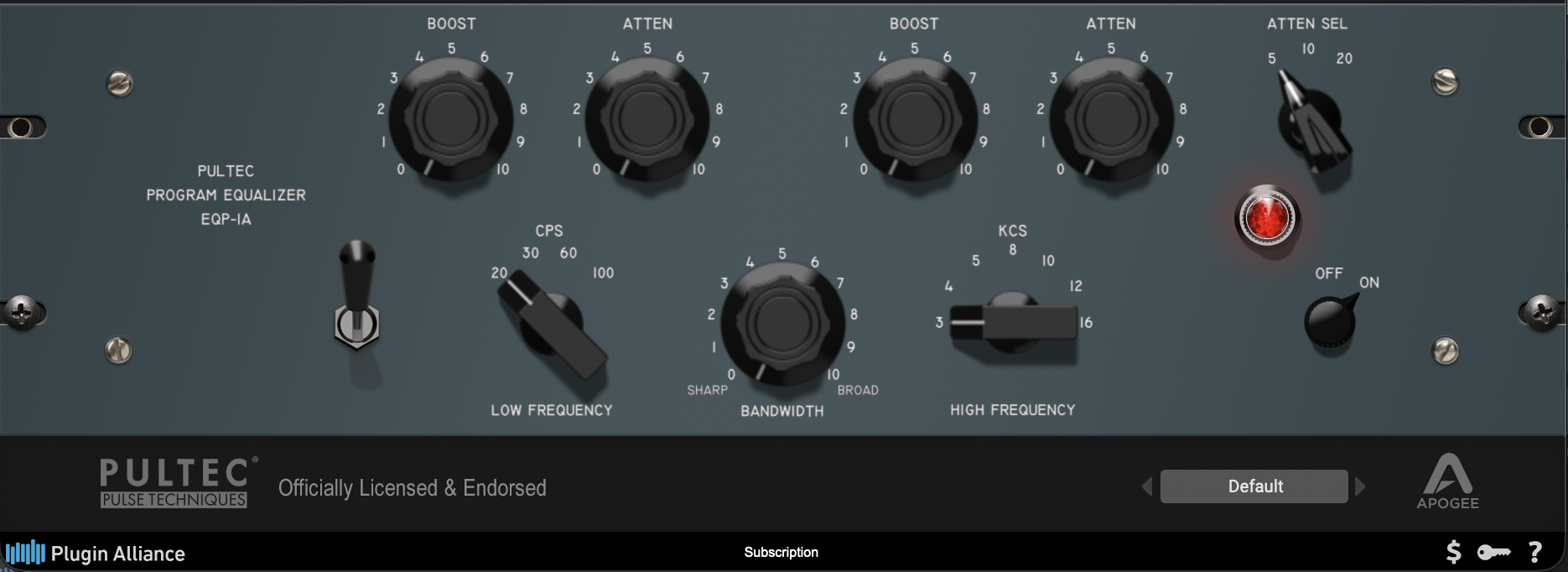
I loaded it up on a drum loop next to the UAD Pultec, which is the one I tend to use quite a bit. I honestly wasn’t expecting a big difference. I was shocked.
The Settings Don’t Line Up
Same knob numbers don’t give you the same sound. With both boosting and attenuating at 100 Hz, I had to move the settings about one number apart to get the two plugins close. And when I say close, I mean kind of close. I probably could have pulled up a curve EQ and matched them perfectly, but I got them in the same ballpark by ear.
The takeaway if you’re switching between Pultecs: don’t copy your settings over and assume you’ll get the same result. Match them by ear.
How They Sound
- Apogee Pultec: a bit warmer and more open, with a thicker low end.
- UAD Pultec: tighter, with more transient to it, and the bass isn’t quite as thick.
On this drum loop, I thought the Apogee version sounded better. It might become the Pultec I go to from here on out. I still need to test it on vocals and a few other sources before I commit, but it’s nice to have another really good Pultec available.
3. Clearmountain’s Spaces
To me, Spaces is a dumbed down version of the Domain, and I mean that in a good way. It actually started as the reverb section of the Domain’s chain before Apogee released it on its own. My guess is the Domain was just too complicated for a lot of people. I’ve been doing this for 20 years and that plugin can get complicated for me.
Spaces is just a reverb. Sometimes that’s all you want. You don’t need the delays and the pitch delays and everything else.
You get three spaces you can blend together:
- Apogee Studio: a short, warm room from Apogee’s in-house studio. I’m a big fan of this one. It sounds really good.
- Mix This!: a brighter, medium-length reverb from the echo chambers at Clearmountain’s own studio in Los Angeles. It can get a little bright, but I like it as well.
- Roscoe: the long, rich one, recorded at a friend’s studio.
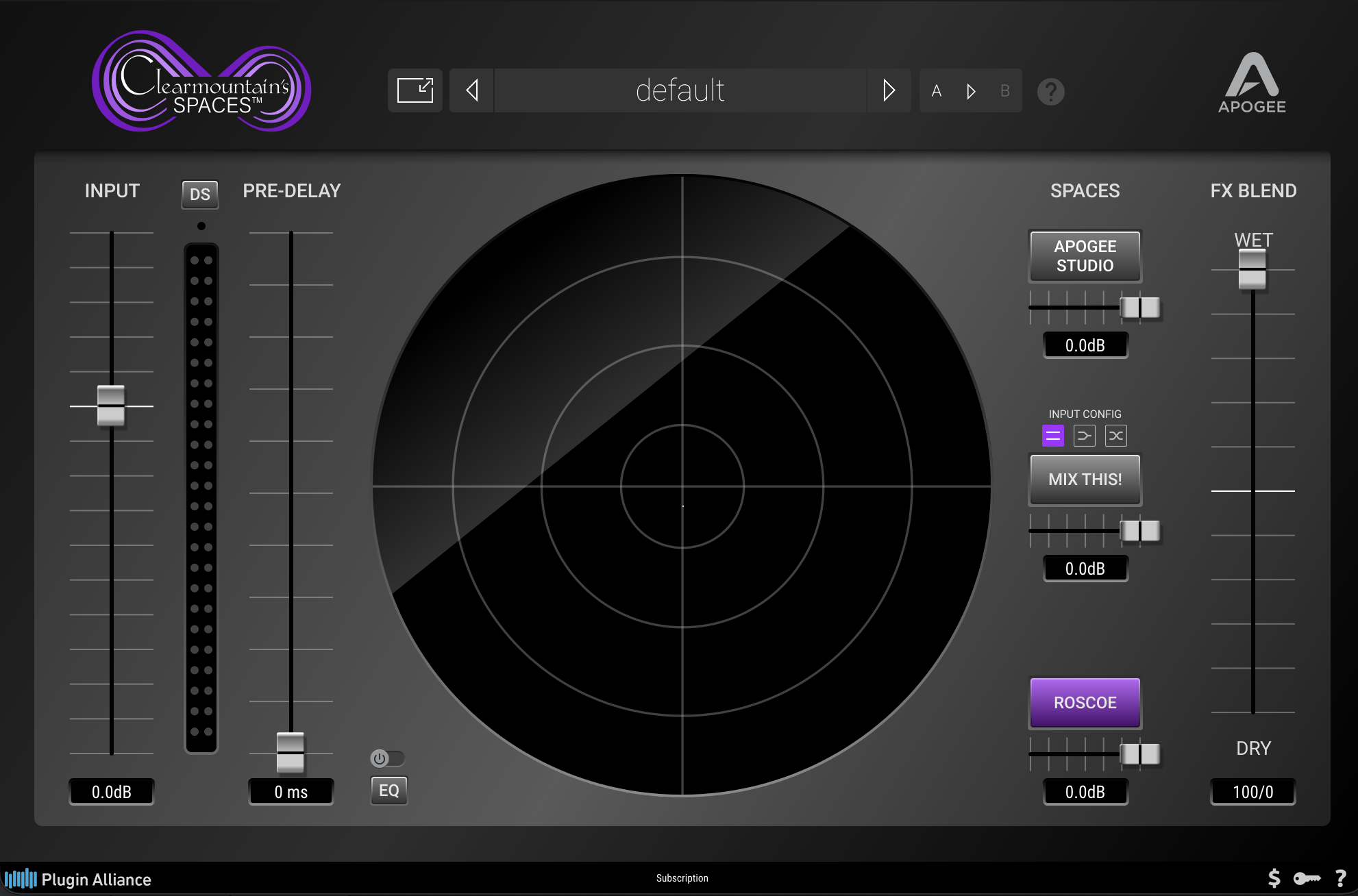
There’s a pre-delay, which is nice, though it’s one control for the whole plugin. I’d love a pre-delay on each space. You also get a de-esser on the input, which is really cool to have on a reverb. On a vocal from Anjail, a really talented artist you should check out, I had a good reverb sound within about a minute. It’s a lot more stripped down than the Domain, but you get there quicker.
Which Apogee Plugin Should You Try First?
- Want a great reverb fast: Clearmountain’s Spaces. Start with the Apogee Studio room.
- Want thicker low end on drums or bass: the Pultec EQP-1A. A/B it against whatever Pultec you use now.
- Want a whole effects chain in one plugin, and have time to learn it: Clearmountain’s Domain. Live in the mixer section.
If you’re already a subscriber, these are worth digging into, and you can browse the full Apogee collection on Plugin Alliance. For more from the same catalog, here are the Plugin Alliance plugins I use on every mix.
Common Questions About Apogee Plugins on Plugin Alliance
Are Apogee plugins included in the Plugin Alliance subscription?
Yes. As a subscriber, I got the Apogee plugins as part of my subscription. The only Apogee plugins that didn’t make the move are the Mod EQ 6 and Mod Comp.
Do Apogee plugins still need an iLok?
Not the Plugin Alliance versions. Your existing iLok versions keep working, and Apogee suggests keeping them installed so older sessions still open.
I already own Apogee plugins. Do I have to buy them again?
No. Existing owners get the Plugin Alliance versions at no charge, with three activations per license.
Is the Apogee Pultec officially licensed?
Yes. Apogee developed its EQP-1A and MEQ-5 with Pulse Techniques, the company that makes Pultec hardware today, and both are officially licensed and endorsed by them.
Who owns Plugin Alliance now?
Its founder, Dirk Ulrich. He bought Plugin Alliance and Brainworx back in July 2026, and they now sit alongside Apogee and Manley in his family-owned company.
Key Takeaways
- Nearly every Apogee plugin is now on Plugin Alliance, without iLok
- Clearmountain’s Domain packs de-essers, two delays, pitch and three reverbs into one plugin, but expect a learning curve
- Apogee’s officially licensed Pultec sounded warmer and more open than the UAD version on drums
- Pultec settings don’t transfer one to one between plugins, so match them by ear
- Clearmountain’s Spaces is the fastest way to a great reverb in the collection
Which Apogee plugin did you dig the most? Let me know in the comments. And if your mixes still aren’t where you want them, send me your rough mix for a free video review, or if you need your songs mixed or mastered, hit me up here.