

My favorite plugin compressor in the world is the CLA 76. I use it on vocals all the time, and out of every vocal compressor I own, it’s the one. I even reach for it over the UAD 1176 plugins. For some reason it just has a sound.
So when Black Lion Audio released the Bluey, a hardware replica of the 1176 the CLA 76 plugin is based on, I had to hear them side by side. I bought it myself. Nobody sponsored this.
Two versions of the same 1176
Both of these come from the same box: Chris Lord-Alge’s own blue stripe 1176. The CLA 76 plugin models it, and the Bluey is a hardware replica that supposedly copies every part of that unit. That matters, because CLA’s 1176 sounds the way it does partly because it’s been modified so many times over the years that it’s a little messed up. That’s the character people want.
The plugin gives you two models. The black face is a little more neutral. The blue face pushes the midrange and gives you the sound I love on vocals. The 1176 has always been my favorite compressor, but I’d never owned a hardware one until the Bluey.
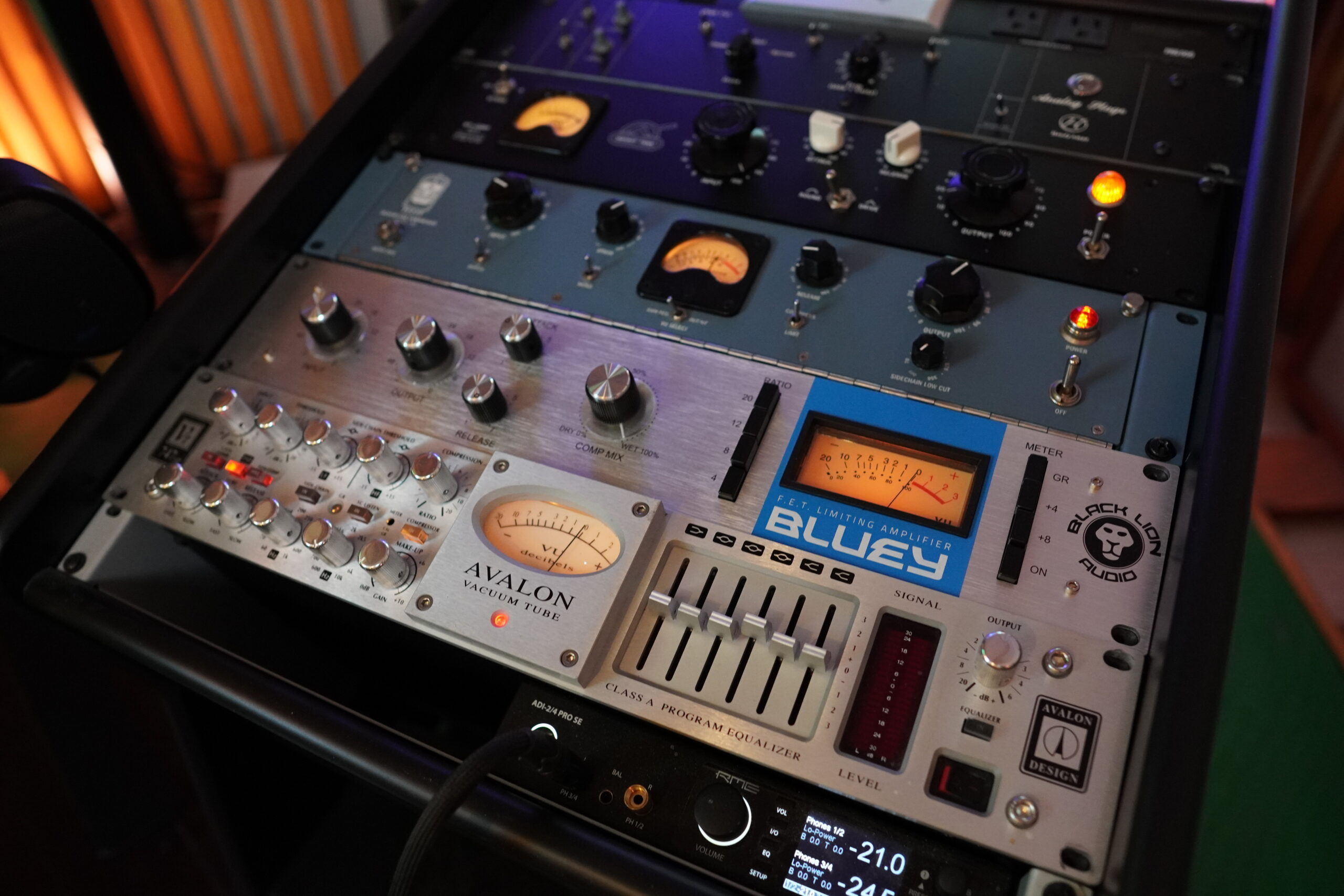
How I set up the test
Each vocal ran through two tracks, one through the Bluey and one through the CLA 76. Attack and release were identical on both. Input and output were slightly different because they react differently, so I matched the gain reduction as closely as I could and then gain matched the outputs.
I hit both pretty hard. That’s how I like to use a blue stripe 1176, and I think that’s what it was made for. Then I switched back and forth phrase by phrase on three very different vocals.
Vocal 1: a dynamic female lead
The first was from La Rebel, a group I mixed. It’s in another language, but the dynamics of this vocal made it a good test. With the same amount of compression, the Bluey sounded more open. Here’s the strange part: on the meters, the CLA 76 was peaking a little more, but it sounded more compressed than the Bluey. There was more clarity in every word coming out of the hardware.
On the next line, both were compressing about the same, but the Bluey added harmonics the plugin didn’t. The CLA 76 sounded cleaner. The Bluey had an edge to it that I actually like. If you wanted a cleaner vocal for a section like that, the CLA 76 would be the pick. To me the Bluey just had more energy and more excitement.
Vocal 2: a gritty, bluesy lead
The second was my friend Nate Amor, a fantastic singer you may have seen on American Idol. He has a big range, and this vocal is gritty and bluesy, so it’s a completely different test.
The first thing I noticed was how the consonants reacted. The D in “nobody” had a little more edge through the Bluey. On the big build, the Bluey had more excitement again, but the two were closer here than on the first vocal. On the next section it was the same story as before: the CLA 76 a little cleaner, the Bluey a little more exciting.
I’m not saying the CLA 76 is worse. That’s not the point. They’re modeled on the same compressor and they sound quite different. Different flavors.
Mixing & Mastering
Want your vocals through the real thing?
I mix and master every song myself, with the Bluey and the rest of my analog chain. Credits include A$AP Rocky, Kelly Clarkson and Travis Barker.
Vocal 3: a vocal that was already compressed
The last vocal came to me already compressed a bit on the way in, unlike the first two, which were much more raw. This is where the difference got smaller. When a compressor is working less, the plugin and the hardware seem a lot closer together.
There was still a difference. The Bluey had a brightness and clarity the CLA 76 didn’t. Not better or worse, just different. The CLA 76 sometimes sounds a little bland, and I don’t mean that in a bad way. It gives you the vocal as it is, with compression and that forward midrange you expect from a blue stripe 1176. The Bluey has more harmonic excitement and sits a little more present in the mids.
So is the hardware worth it?
Here’s how I’d sum it up after three vocals:
- Hitting a vocal hard: the Bluey sounds more open and more exciting at the same gain reduction. This is where the hardware earns its place.
- Light compression, or a vocal that’s already compressed: the two get much closer, and the CLA 76 will get you most of the way.
- When you want it clean: the CLA 76 is the cleaner of the two, and sometimes that’s exactly what a section needs.
If you’re working in the box, the CLA 76 is still my favorite plugin compressor, and it isn’t going anywhere. If you lean on an 1176 the way I do, the Bluey adds something the plugin doesn’t. I’ve had the same experience with other analog comparisons, like the Silver Bullet MK2 plugin vs the hardware and Kiive Nfuse vs the analog units. For how I set attack times on vocal compressors in general, see when to use fast attack compression.
Which one did you prefer? Tell me in the comments. And if you want your vocals run through the Bluey on your next release, that’s part of my mixing and mastering services.