
That $25 mixing offer on Fiverr looks tempting, doesn’t it?
You’ve spent weeks writing your song, countless hours in your home studio getting the perfect take, and now you’re staring at your budget wondering how to make it all come together. When you see “professional mixing and mastering” for the price of a couple coffees, it’s hard not to click.
But here’s what nobody tells you: there’s a massive difference between “affordable” and “cheap” when it comes to mixing services. And that difference could be the deciding factor between your song getting added to playlists or getting skipped in the first ten seconds.
I’ve been mixing and mastering for over 20 years, working with everyone from major label artists to indie musicians releasing their first single. I’ve seen both sides of this equation, and I’m going to break down exactly what you need to know to make a smart decision with your hard-earned money.
What “Cheap” Actually Costs You
The real cost of bottom-dollar mixing isn’t just the money you spend—it’s everything you lose in the process.
Lost Opportunities You Can’t Get Back
Playlist curators make decisions in seconds. I’m not exaggerating—research shows that most curators skip a track within the first 5-10 seconds if the production quality doesn’t meet their standards. That muddy low end or that vocal sitting wrong in the mix? It’s an instant rejection.
Sync licensing opportunities are even more unforgiving. Music supervisors need broadcast-quality audio, and they can tell immediately when a track isn’t up to standard. They’re not going to reach out and suggest you get it remixed—they’ll just move on to the next submission.
I’ve had multiple artists come to me after receiving feedback like “love the song, but the mix needs work” from Spotify’s editorial team or playlist curators. At that point, they’ve already burned the opportunity. You don’t usually get a second chance to submit the same track.
The Re-Do Tax
Here’s the painful reality I see all the time: An artist pays $25 for mixing, realizes the result is unusable, and then has to pay a professional rate to fix it or start over. They’ve essentially paid twice for one song, and they’ve lost valuable time in the process.
But the timeline delay might hurt even more than the money. If you’re trying to build momentum with a release, missing your launch date by weeks or months while you scramble to fix a bad mix can kill all the buzz you’ve been building. Your social media campaign stalls, your pre-save numbers plateau, and by the time you finally release, the moment has passed.
And there’s an emotional cost too. Hearing your song—something you’ve poured your heart into—come back sounding worse than when you sent it out is genuinely heartbreaking. I’ve been on calls with artists who were so discouraged by a cheap mix that they almost shelved the entire project.
Damaged Credibility
In the streaming era, your music introduces you before you ever get a chance to explain yourself. New listeners don’t know that you got a budget mix. They just know your song sounds amateurish compared to everything else in their playlist.
Industry gatekeepers have long memories. A&R reps, playlist curators, music supervisors—they all keep mental notes. If they hear subpar production from you once, it colors their perception of your brand. Even if your next release is perfect, they might not give you the same attention because they remember the quality issues from before.
Your artist brand is built on every release. One poorly mixed track doesn’t just affect that song—it affects how people perceive your entire catalog and your professionalism as an artist.
Red Flags of “Cheap” Services
Here’s how to spot services that will waste your money before you even send them a deposit.
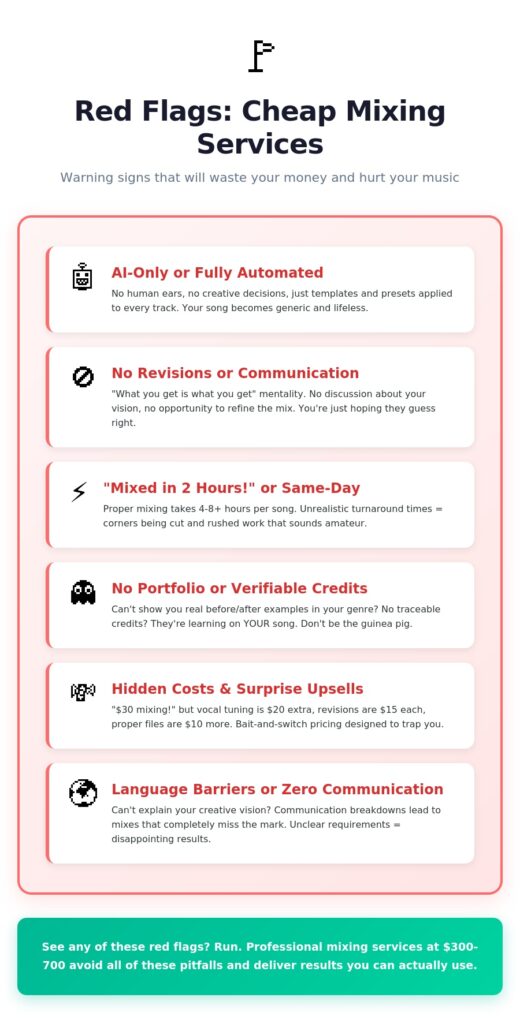
AI-Only or Fully Automated Mixing
There’s nothing inherently wrong with AI as a tool—I use AI-assisted plugins in my own workflow. But when a service relies entirely on automation with no human oversight, you’re getting a one-size-fits-all approach that can’t make creative decisions.
Algorithms can’t understand that you want your vocal to have that slightly raw, intimate quality, or that the slightly muddy guitar tone is intentional because it gives the track character. They just apply templates and presets, often making your song sound like every other track that’s gone through their system.
Some of these services will make your mix technically “correct”—nothing is clipping, levels are balanced, frequencies aren’t clashing—but technically correct and artistically compelling are very different things. Music isn’t just about avoiding mistakes; it’s about making intentional creative choices.
No Communication or Revision Policy
This is a huge red flag. If a service has a “what you get is what you get” mentality with no opportunity for revisions, they’re essentially saying they don’t care if you’re happy with the result.
Professional mixing is a collaborative process. Even when I’m working with major artists who have extensive experience, we go through revisions. That’s not a bug in the process—it’s a feature. It’s how we dial in exactly what the artist is hearing in their head.
Services that don’t gather context before mixing—asking about your references, your vision, the vibe you’re going for—are flying blind. They’re just making educated guesses about what you want and hoping it sticks.
Unrealistic Turnaround Times
I saw an ad recently that said “professionally mixed and mastered in 2 hours!” Let me tell you what that actually means: they’re running your track through a chain of presets and calling it done.
Proper mixing takes time. On average, I spend 4-8 hours per song, sometimes more for complex arrangements. That’s not because I’m slow—it’s because I’m actually listening critically, making thousands of small decisions, checking the mix on different systems, and ensuring everything translates properly.
When someone promises same-day or 24-hour turnaround at budget prices, they’re absolutely cutting corners. They have to be, because the math doesn’t work otherwise. Quality mixing simply cannot be rushed.
Suspiciously Low Prices with No Portfolio
A lot of budget services are being run by people who are still learning. And look, everyone has to start somewhere—I was that person once. But do you really want someone to practice on your song, especially when you’re paying them?
If someone is charging $15-50 for mixing and they can’t show you verifiable before/after examples in your genre, that’s your answer right there. Either they don’t have experience, or the results aren’t good enough to showcase.
Language barriers can also become an issue with overseas services. I’m not talking about accents—I’m talking about the inability to communicate nuanced creative direction. When you can’t effectively explain what you’re hearing in your head, the engineer can’t deliver it.
Hidden Costs and Upsells
This one drives me crazy. A service advertises “$30 mixing” but then you find out that’s just for balance and EQ. Vocal tuning is an extra $20. Revisions are $15 each. The proper file deliverables are another $10. By the time you add everything you actually need, you’re at $95—which is exactly what a straightforward service would have charged you from the beginning, except now you’re annoyed and feeling manipulated.
These bait-and-switch tactics are designed to get you in the door with a low number, knowing that once you’ve committed, you’ll likely pay for the add-ons rather than start over somewhere else.
What “Affordable Quality” Actually Means
So if cheap is a trap, what should you actually be looking for? Let me break down what I consider the sweet spot for indie artists.
Fair Value ≠ Cheap
For most independent artists, the $300-700 range per song is where you start getting real, professional results that can compete with major releases. I know that might sound like a lot if you’re used to seeing $25 offers, but let’s talk about what you’re actually paying for.
At this level, you’re getting an experienced engineer who knows your genre inside and out. They understand the production conventions, the mix aesthetics, what works and what doesn’t. They’ve made the mistakes on someone else’s tracks, not yours.
You’re getting someone with a proper monitoring environment—quality speakers in a treated room that allows them to make accurate decisions. Home studio setups are great for recording, but mixing requires a level of acoustic accuracy that most bedrooms simply can’t provide.
You’re paying for time. Real, undivided attention on your song. Not a template, not a preset chain, not an algorithm—an actual human being listening critically and making creative decisions that serve your music.
And here’s the thing about return on investment: One properly mixed track that gets added to major playlists will earn back that $300-700 many times over. But even beyond streaming revenue, think about the opportunities it opens up. Professional quality gets you taken seriously. It gets you that sync placement. It gets you the attention of that A&R rep. It positions you as someone who’s ready for the next level.
What You Should Get at Affordable Rates
Let me paint a clear picture of what professional service at accessible prices looks like, because this is what you should expect and demand.
Real human oversight and decision-making. Every choice in your mix should be made by an actual engineer who’s listening critically. When I mix a song, I’m making hundreds of micro-decisions—should this reverb tail be 2.3 seconds or 2.5? Should I compress the bass before or after the EQ? Should this vocal double sit 3dB down or 5dB down? Those decisions matter, and they require human judgment.
Genre expertise. Mixing hip-hop is different from mixing country is different from mixing indie rock. The mix aesthetics, the typical balances, the way vocals sit, the low-end treatment—all of it varies by genre. You want someone who regularly works in your style and understands the reference points.
Actual communication about your vision. Before I touch a fader, I ask about reference tracks, the vibe you’re going for, any specific elements you want emphasized or de-emphasized. That conversation shapes everything I do, and it’s just as important as the technical execution.
Revisions until it’s right. Professional services include multiple rounds of revisions, and the best ones offer unlimited revisions for first-time clients. That’s not because they can’t get it right the first time—it’s because they understand that finding the perfect balance is a collaborative process.
Proper deliverables for all platforms. You should receive properly formatted WAV files, optimized for streaming platforms, with appropriate headroom and loudness targets. If you’re releasing on vinyl or need specific formats, those should be included or available.
Realistic turnaround times that allow for quality. Standard turnaround should be 3-5 business days for an initial mix, with revisions turned around in 24-48 hours. Rush options should be available but should cost extra because they require the engineer to rearrange their schedule.
The Gear Matters, But the Ears Matter More
Here’s something that confuses a lot of artists: A talented engineer with a modest setup and mostly plugins will consistently deliver better results than an inexperienced engineer in a $100,000 studio.
I use analog gear in my workflow—I love what it brings to certain elements. But I’ve also done incredible mixes entirely in the box with only plugins. The tools matter, but the person using them matters infinitely more.
This is actually why online mixing services can offer studio-quality results at accessible prices. We’re not paying overhead for a commercial space that sits empty half the time. We’re not marking up our rates to justify expensive equipment. We can focus the budget on what matters: experienced ears and sufficient time to do the job right.
When Budget Services CAN Work
Look, I’m not saying you should never take the budget route. There are specific situations where it makes sense, and being strategic about when you invest heavily versus when you can save is part of smart career management.
Demos and Rough Ideas
If you’re just tracking ideas to see if a song has legs, or you’re sending rough versions to potential collaborators or your band to get feedback, you don’t need a professional mix. A decent rough mix—or even just a good balance—is fine for these purposes.
The demo phase is about the song, not the production. You’re testing melodies, arrangements, whether the chorus hits right. Save your mixing budget for when you’ve decided this is a song you’re actually releasing.
Early Releases While Building Your Audience
If you’re releasing your first few songs and you’re still building your audience from scratch, you might want to prioritize volume over perfect production. Getting three decent releases out there might serve you better than one perfectly mixed track, especially in the early days when you’re still finding your sound and your audience.
That said, even here there’s a floor. Even if your audience is small, whatever you put out should be at least competent. You’re still building your brand, and you don’t want people’s first impression to be that you put out amateurish-sounding tracks.
DIY Mixing with Professional Mastering
If you’ve invested serious time learning to mix and you’ve developed your skills to a respectable level, doing your own mixing and hiring a professional mastering engineer can be a smart middle ground. Mastering is generally more affordable than full mixing services, and it can take a good DIY mix to the next level.
The key word here is “good DIY mix.” If you’re still struggling with basics like getting your vocal to sit right or managing your low end, you’re not ready to be mixing your own releases yet. Be honest with yourself about your skill level.
Genre Considerations
Some genres benefit from—or even require—a raw, DIY aesthetic. Lo-fi hip-hop, bedroom pop, certain types of indie rock—these styles can actually lose something if they’re too polished.
But here’s the thing: Even records that sound “lo-fi” or raw are usually carefully crafted to sound that way. And even these genres benefit enormously from professional mastering to ensure they translate across different playback systems.
If you’re working in one of these genres, you still want someone who understands the aesthetic. You don’t want generic “make it clean” treatment. You want someone who gets that the tape hiss is supposed to be there, that the slightly distorted vocal is a choice, that the out-of-tune synth is the vibe.
* { margin: 0; padding: 0; box-sizing: border-box; } body { font-family: ‘Inter’, sans-serif; background: white; padding: 0; margin: 0; } .chart-container { max-width: 1000px; margin: 0 auto; padding: 50px 30px; } .chart-header { text-align: center; margin-bottom: 50px; } .chart-title { font-family: ‘Outfit’, sans-serif; font-size: 36px; font-weight: 800; color: #1a1a2e; margin-bottom: 10px; } .chart-subtitle { font-size: 16px; color: #64748b; font-weight: 500; } .chart-main { background: linear-gradient(135deg, #f8f9fa 0%, #e9ecef 100%); border-radius: 20px; padding: 40px; box-shadow: 0 10px 40px rgba(0, 0, 0, 0.08); } .bars-section { margin-bottom: 50px; } .bar-group { margin-bottom: 35px; } .bar-label { display: flex; justify-content: space-between; align-items: center; margin-bottom: 12px; } .bar-name { font-family: ‘Outfit’, sans-serif; font-weight: 800; font-size: 18px; color: #1a1a2e; } .bar-price { font-family: ‘Outfit’, sans-serif; font-weight: 600; font-size: 20px; color: #1a1a2e; } .bar-wrapper { position: relative; height: 50px; background: white; border-radius: 10px; overflow: hidden; box-shadow: inset 0 2px 8px rgba(0, 0, 0, 0.05); } .bar-fill { height: 100%; display: flex; align-items: center; justify-content: flex-end; padding-right: 15px; font-family: ‘Outfit’, sans-serif; font-weight: 800; font-size: 18px; color: white; transition: width 1.5s cubic-bezier(0.4, 0, 0.2, 1); width: 0; } .bar-fill.animate { width: var(–bar-width); } .bar-budget { background: linear-gradient(90deg, #ff6b6b 0%, #ee5a6f 100%); } .bar-sweet { background: linear-gradient(90deg, #00b894 0%, #00d2a0 100%); box-shadow: 0 4px 20px rgba(0, 184, 148, 0.4); } .bar-high { background: linear-gradient(90deg, #6c5ce7 0%, #a29bfe 100%); } .features-grid { display: grid; grid-template-columns: repeat(3, 1fr); gap: 25px; margin-top: 40px; } .feature-column { background: white; border-radius: 12px; padding: 25px 20px; box-shadow: 0 4px 15px rgba(0, 0, 0, 0.06); } .feature-column.budget { border-top: 4px solid #ff6b6b; } .feature-column.sweet { border-top: 4px solid #00b894; position: relative; } .feature-column.sweet::before { content: “⭐ BEST VALUE”; position: absolute; top: -12px; left: 50%; transform: translateX(-50%); background: #00b894; color: white; padding: 4px 12px; border-radius: 12px; font-size: 11px; font-weight: 700; letter-spacing: 0.5px; white-space: nowrap; } .feature-column.high { border-top: 4px solid #6c5ce7; } .feature-header { font-family: ‘Outfit’, sans-serif; font-weight: 800; font-size: 16px; color: #1a1a2e; margin-bottom: 15px; text-align: center; } .feature-list { list-style: none; } .feature-item { display: flex; align-items: flex-start; margin-bottom: 10px; font-size: 13px; line-height: 1.5; color: #2d3436; } .feature-icon { margin-right: 8px; font-size: 14px; flex-shrink: 0; margin-top: 2px; } .check { color: #00b894; } .cross { color: #ff6b6b; } .chart-footer { text-align: center; margin-top: 40px; padding: 25px; background: linear-gradient(135deg, #00b894 0%, #00d2a0 100%); border-radius: 12px; color: white; } .footer-text { font-size: 15px; line-height: 1.7; font-weight: 500; } .footer-text strong { font-weight: 700; } .value-scale { display: flex; justify-content: space-between; align-items: center; margin-top: 15px; padding: 0 40px; font-size: 13px; color: #64748b; font-weight: 600; } @media (max-width: 768px) { .features-grid { grid-template-columns: 1fr; gap: 20px; } .chart-title { font-size: 28px; } .chart-container { padding: 30px 20px; } .chart-main { padding: 25px 20px; } }
Mixing Service Value Comparison
Quality vs. Cost: Where Indie Artists Get the Best ROI
- Basic balance
- Generic presets
- Limited revisions
- No creative input
- Inconsistent quality
- Often needs re-do
- Experienced engineer
- Real human decisions
- Multiple revisions
- Direct communication
- Pro monitoring setup
- Radio-ready results
- All file formats